
What is EU Doing to Prepare the Youth for an AI Future
Europe isn’t sitting still while Gen Z and Gen AI collide — there’s real policy and real classrooms changing right now.
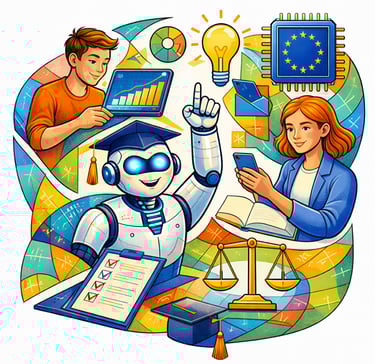
Several policies, acts and actions show that the EU is not approaching AI as a purely technological race, but as a societal transformation — one that requires rules, education, participation, and long-term preparation of young people. EU is deliberately positioning itself as a global leader in shaping AI through regulation, education, and youth empowerment, rather than leaving its impact to market forces alone.
That is to be expected given the seriousness of such a union, since AI is not just a technology, but something that will shape young people’s education, jobs, rights, and everyday lives.
1) The AI Act — rules first, safe foundation next
The European Union’s Artificial Intelligence Act is the world’s first comprehensive law regulating AI systems. It entered into force on 1 August 2024 and is being rolled out in stages. Its job is to make sure AI systems are safe, fair, and respect human rights — not just powerful and profitable. It applies to all kinds of AI that young people will encounter in school, work, or everyday life.
These rules will shape what tools schools and employers can use, how data about students is protected, and when AI needs human oversight.
2) Practical AI education initiatives in classrooms
Europe is moving from theory to action. A programme called AI-ENTR4YOUTH is already teaching AI in real schools across at least 10 European countries — including Italy, Spain, Portugal, France, Greece, Romania, and even Albania and Bulgaria. It helps students build applied AI projects and brings entrepreneurship into AI education.
A 2024 study of 7,000 young people aged 12–17 found that 74% expect AI to strongly influence their future careers, yet only 46% feel their schools currently prepare them for this reality.


3) Updated guidelines for AI and learning
Instead of AI being this “off-limits or risky topic,” there is now an official push to integrate it into schooling thoughtfully.
The EU’s youth policy documents — such as the Digital Education Action Plan — now include guidelines on AI and data use in teaching. These aim to give teachers and students practical, age-appropriate guidance so AI is used responsibly and safely in classrooms.
4) Youth voices in policy and governance
Across Europe, young people are being invited into consultative processes about AI, rights, and digital citizenship. The Council of Europe (which complements EU efforts) hosts seminars and develops resources on how AI affects human rights, democracy, and youth policy, encouraging youth participation in shaping AI futures.
These organizations are practically recognizing this transformative technology not just as a tools — it’s about being part of decisions that affect human and youth rights, work, and life in general.
5) Skills frameworks and literacy
The World Economic Forum and partners — including the European Commission and OECD — are developing AI literacy frameworks. These aim to go beyond basic coding and teach critical thinking about AI — like how to evaluate outputs and understand limitations. This is part of larger efforts to make AI literacy a core education goal, not an optional “tech club” skill.
Background on AI literacy push: What it all adds up to
Regulation (AI Act) is creating safer and more predictable environments for youth and schools.
Practical education initiatives are bringing AI skills into classrooms.
Policy guidance is being developed so teachers and students know how to use AI responsibly.
Youth participation in governance is increasingly recognized as essential.
AI literacy frameworks are pushing beyond simple tech skills toward ethics and judgment.These are the ethical principles and strategic directions where our Think Tank also works, having been active for over a year.
These are the ethical principles and directions where our Think Tank also works, having been active for over a year - in line with the EU’s direction, we believe AI must be safe, understandable, and shaped with young people — not imposed on them. AI should empower learning, strengthen judgment, and respect human values, not replace them.